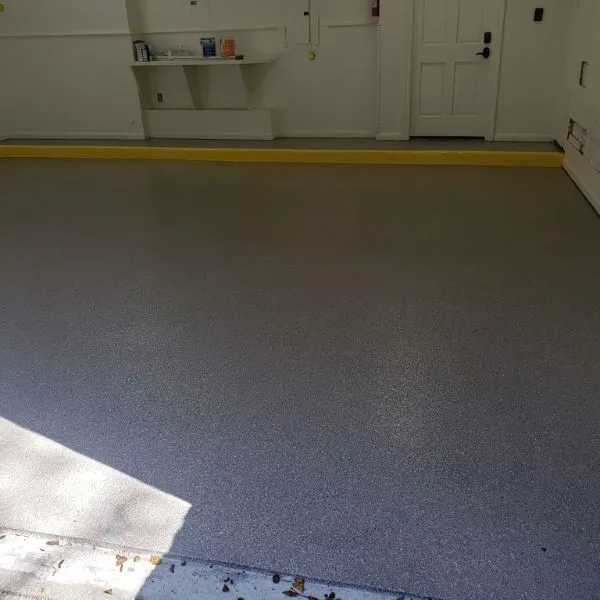
In Southwest Florida, an epoxy floor earns its keep precisely because it shrugs off the things our homes throw at it — Gulf salt air, beach sand, summer humidity, and a garage that bakes shut while you are up north. Keep grit swept off it, damp-mop with a pH-neutral cleaner, rinse coastal salt away, and steer clear of acids, vinegar, citrus degreasers, and abrasive pads. That is the entire job.
Here in Lee County the appeal of epoxy is not just looks — it is that the seamless, non-porous surface gives sand, salt, and standing water nothing to grab onto. There are no grout lines for grit to lodge in, no pores for tracked-in beach sand to wear down, and nothing for a dropped quart of oil to soak into. On a slab that has been diamond-ground and properly coated, the maintenance is genuinely a few minutes a week, even on a barrier-island home a block from the water.
What this guide does that a generic care article will not: it folds in the realities of a Cape Coral, Estero, or Fort Myers Beach floor — the seasonal-home shutdown, the canal-and-Gulf salt load, the post-Ian rebuild boom that put fresh coatings in thousands of local garages. Whether you run a flake garage floor in San Carlos Park or a metallic interior in Gateway, the day-to-day care is the same handful of habits. If your floor is past the point cleaning fixes, call our crew at (239) 320-7135 for a free, no-pressure assessment.
The Simple Weekly Routine
Strip away the local detail and the whole routine is three habits: get the sand off, wet-clean now and then, and catch spills early. In Southwest Florida the first one carries most of the weight — our floors see more abrasive grit than almost any inland market, so a broom matters here more than a mop.
- Sweep or dust-mop — and in Lee County, often. Beach and yard sand is the enemy of any clear coating. Ground in under shoes or tires, those fine quartz grains act like sandpaper and slowly take the gloss down. A soft-bristle broom or microfiber dust-mop pass clears it before it can scratch. A Cape Coral or Estero garage that sees daily traffic does best with a quick pass every two or three days, not the once-a-week most guides suggest.
- Damp-mop with a pH-neutral cleaner. Monthly — or whenever the surface looks hazy — mix a pH-neutral floor cleaner with warm water and go over the floor with a flat microfiber pad. Work in sections, then pass again with clean water to rinse. The rinse is not optional on a coastal floor: leftover cleaner and dissolved salt dry into a film that dulls the shine.
- Spot-clean spills as they happen. Because the coating is non-porous, almost nothing penetrates if you reach it quickly. Blot oil, paint, pool chemicals, or fertilizer with a cloth or paper towel, clean the spot with your pH-neutral cleaner, and rinse. The faster you act, the less chance anything has to set.
For a working two-car garage in San Carlos Park or Lehigh Acres, plan on a sweep every few days and a monthly mop; a closed-up interior floor in a seasonal home stretches far longer between cleanings. Note what is not on this list: no waxing, no sealing, no polishing. Those belong to tile and bare concrete, not to a quality epoxy or polyaspartic system, and a contractor who tells you a coated floor needs annual sealing is selling you something it does not need.
What NOT to Use on an Epoxy Floor
A surprising share of the dull, tired floors we get called out to look at in Lee County were never worn out by use — they were quietly ruined by the cleaning cabinet. The topcoat laughs off impact, oil, and pool chemicals, but a few everyday products etch or scratch it for good. Two of these are especially easy to grab in a Florida garage, so they sit at the top of the list below.
| Keep Off the Floor | What It Does | Reach For This Instead |
|---|---|---|
| Muriatic acid & concrete etchers | Common in Florida garages for cleaning pavers and pool cages — one splash etches the topcoat to a permanent haze | A pH-neutral floor cleaner, kept well away from the etch jug |
| Vinegar & citrus "natural" cleaners | Acidic; repeated use dulls and etches the clear coat | A cleaner labeled for coated or sealed floors |
| Pool chlorine & bleach (left to sit) | Splashed near a lanai or pool deck, they can bleach and cloud the finish over time | Rinse splash off promptly with clean water |
| Steel wool, wire brushes & scour pads | Leave fine scratches that catch the Gulf sun and look cloudy | A soft deck brush or white non-abrasive pad |
| Strong solvent degreasers | Acetone and harsh strippers can soften or cloud the coating | A diluted pH-neutral degreaser, rinsed off |
The rule of thumb holds anywhere, but it bites harder here: nothing acidic, nothing abrasive, nothing left to sit. The two products most likely to wreck a Southwest Florida floor — muriatic acid and pool chlorine — are the same ones half of us keep within arm's reach of the garage. Store them away from the coated floor, and if a label brags about being a heavy-duty stripper or a "deep-etch" formula, it has no business near your epoxy.
South Florida-Specific Care
Most epoxy-care advice you find online is written for a dry, two-season inland garage. Southwest Florida is the opposite of that. Between the Gulf, the canals, the heat, and the long stretches when seasonal homes sit closed, Lee County floors deal with conditions a Midwest garage never sees. Adjust for them and your finish outlasts the manufacturer's claim; ignore them and a coating ages years before it should.
Salt Air and Beach Sand — the Coastal Double Hit
This is the one that defines a Southwest Florida floor. From Sanibel and Fort Myers Beach to the canal lots of Cape Coral, two things ride in constantly: dried salt off the Gulf air, and fine beach and yard sand on shoes, tires, paws, and fishing gear. The sand is straight-up abrasive — it scratches the clear coat when it gets dragged around. The salt is sneakier; left on the surface it draws moisture and dries into a gritty haze. A walk-off mat at the door from the lanai or driveway catches most of it, and sweeping every couple of days beats any product for keeping the gloss. On homes right on the water, an occasional clean-water rinse flushes the salt that a broom leaves behind.
Humidity and the Closed-Up Seasonal Garage
Lee County humidity runs high most of the year, and a cool slab will sweat when warm, wet air hits it, leaving a film of condensation on top. The coating is waterproof, so this does no harm — but it makes the surface briefly slick and can bake tracked-in salt into a haze if it dries in place. The bigger local wrinkle is the snowbird home: a garage sealed up from May through October traps humidity with no airflow, so a floor that was spotless in April can come back to a dusty, filmy surface. Before you leave for the season, sweep and rinse, and crack a window or run the AC's fan setting if you can; on your return, a single damp-mop usually brings it right back.
Lanai, Pool Deck, and Open-Bay Floors
So many Lee County homes have a coated lanai or pool deck, and those surfaces take the full Florida menu: relentless sun, chlorine splash, salt, and tracked sand. Hose them off regularly to flush chlorine and salt before either builds up, sweep the grit, and do not leave rubber mats, wet towels, or planters parked in one spot for weeks — trapped moisture and color bleed from rubber can leave marks. The sun is the other factor, which is why we spec a UV-stable polyaspartic topcoat for anything exposed out here; even so, rinsing chlorine and salt off helps an outdoor floor hold its color and clarity through a Southwest Florida summer.
Floor Hazed Over or Peeling After a Season Away?
If sweeping and mopping no longer bring the shine back — or a closed-up garage came back worse than you left it — the topcoat may be ready for a refresh. Our crew will take a look and give you a real Lee County number, free.
Removing Common Stains
Because the coating is non-porous, almost every stain sits on top rather than soaking in, so the golden rule is to deal with it while it is fresh and never reach for an acid. Here are the four we get asked about most around Lee County — the last one being very much a Florida special.
Hot-Tire Marks
A car parked on a sun-baked Florida slab runs its tires hot, and hot rubber can grab at a weak coating and leave cloudy or sticky patches where it sits — "hot-tire pickup." Work a pH-neutral or epoxy-safe degreaser into the spot, let it dwell a few minutes, agitate with a soft deck brush or white pad, and rinse. Repeat rather than reaching for anything abrasive. A properly installed flake floor with a polyaspartic topcoat shrugs this off, so if marks keep coming back easily, the topcoat is probably thin — worth a look before it gets worse.
Oil and Grease
Engine oil, transmission fluid, and the like wipe off easily when caught early, because a sealed floor will not let them soak in the way bare concrete does. Blot the bulk with a paper towel, work in a diluted pH-neutral degreaser, let it sit briefly, then wipe and rinse. An older, set-in spot usually clears on a second pass. Skip the strong solvent degreasers that can soften the finish.
Rust
In our salt-air climate, rust shows up fast wherever metal meets a damp floor — a jack stand, a tool left out, the foot of a steel shelf. Lift the object, dry the area, then work the mark with a soft nylon brush and a pH-neutral cleaner and rinse. Do not grab a rust remover off the shelf; nearly all of them are acidic and will etch the topcoat. Felt pads or a barrier under metal feet stop it coming back — doubly worth doing near the coast.
Pool Chemicals, Fertilizer & Paint
This is the Florida-garage category. Spilled chlorine tablets, liquid pool shock, and lawn fertilizer are all common here and all capable of bleaching or etching a coating if they sit — sweep up and rinse them off right away, never let them dissolve in place. Latex paint and most household spills wipe up while wet; if paint has dried, soften it with warm soapy water and lift it with a plastic scraper held flat — never a metal blade or razor that can gouge the coating — then rinse. The seamless surface is forgiving as long as you act before anything cures and keep your tools soft.
Protecting the Finish (and When to Recoat)
Cleaning keeps a floor looking good; a few small protective habits keep it that way through season after season. The clear topcoat is a sacrificial wear layer — the gentler you are with it, the longer it goes before it needs any attention, and that matters more on a coastal floor that already works harder than most.
- Put a walk-off mat at every entry. The single best move in Lee County: a sturdy mat where the garage meets the driveway and another inside any door off a lanai or pool deck, catching beach sand and salt before they ever reach the coating. This does more than any cleaner.
- Use mats under tires and jack stands. A mat where the car parks catches hot-tire transfer and grit, and a pad under a jack stand keeps point loads and metal off the finish.
- Pad furniture, shelving, and toolboxes. Felt pads or soft casters under a workbench, rolling tool chest, or storage shelf stop point-load scratches and the rust marks salt air loves to start.
- Lift heavy things, never drag them. Carry or dolly jacks, ramps, ladders, and cabinets. Dragging metal grinds grit into the coating and is the fastest way to leave a scratch cleaning cannot fix.
- Rinse before and after a season away. On a snowbird or rental property, a quick hose-down to clear salt before you close up — and again when you return — keeps the finish from hazing while the garage sits shut.
Even cared for well, the clear wear coat slowly thins over years of use, and a salt-and-sun environment uses it up a little faster than a dry inland one. When a floor looks permanently dull despite proper cleaning, that is usually the topcoat telling you it is due for a refresh — not a sign the floor is failing. Blake's crew can scuff and lay a fresh wear coat over a sound floor, restoring the gloss for a fraction of a full rebuild. How long yours lasts depends on traffic and coastal exposure; our guide on how long epoxy floors last in Lee County breaks it down.
When to Call a Pro
Routine care is a homeowner job, but a handful of signs mean it is time to put the brush down and call someone in. Knowing the difference keeps you from either over-scrubbing a stain that will not move or letting a real problem spread — and in Lee County, one of these is far more common than people expect.
- Deep or set-in stains that will not lift. If a stain survives a couple of proper cleaning passes, a pro has the safe products to clear it without risking the finish, and can tell you whether a recoat is the smarter fix.
- A dull, worn topcoat cleaning will not revive. When the gloss is gone for good in the parking and walking lanes, the wear layer is spent and the floor wants a recoat, not more elbow grease.
- Any peeling, bubbling, or blistering — the big one here. Coating that lifts, bubbles, or flakes off is almost never a cleaning issue. In Southwest Florida it usually means moisture is pushing up through the slab from our high water table, a problem that started before the floor was ever coated and will not fix itself. After Hurricane Ian, plenty of Lee County slabs took on water and were re-coated in a hurry without a proper moisture test — if your floor dates to that window and is delaminating, this is very likely why. Our guide on why epoxy floors fail in Lee County walks through the moisture test that catches it.
For any of these, an in-person look beats guesswork — the assessment is free. While you are weighing it, our breakdown of epoxy flooring cost in Lee County shows what a recoat or a fresh system actually runs locally (a quality two-car flake garage generally lands in the $2,000–$4,500 range, or $4,000–$5,500 with a polyaspartic topcoat over it, and more for a metallic finish), so you can decide before you call.
Frequently Asked Questions
How do I clean an epoxy floor in Southwest Florida?
Start with the broom: in Lee County, beach and yard sand is the main thing that wears a coating, so dust-mop or soft-broom the grit off every couple of days. Then damp-mop with a pH-neutral cleaner in warm water and rinse, which also clears tracked-in salt. Wipe spills as they happen, and keep acids, vinegar, and abrasive pads off the floor. Near the water, an occasional clean-water rinse flushes the salt a broom leaves behind.
Can I use vinegar or muriatic acid on an epoxy floor?
No to both, and muriatic acid is the bigger trap in a Florida garage where it gets kept for cleaning pavers and pool cages — one splash etches the topcoat to a permanent haze. Vinegar and citrus "natural" cleaners do the same thing slowly. Use a pH-neutral floor cleaner instead and rinse with clean water so no film is left behind. Store the acid jug well away from the coated floor.
How do I remove hot-tire marks from epoxy?
A car parked on a hot Florida slab can leave cloudy or sticky rubber patches where the tires sit. Apply a pH-neutral or epoxy-safe degreaser, let it dwell a few minutes, then agitate gently with a soft deck brush or white pad and rinse. Never use steel wool or acidic strippers. A properly installed flake floor with a polyaspartic topcoat shrugs off hot-tire pickup, so marks that keep coming back easily can signal a thin topcoat worth a professional look.
Will pool chlorine or fertilizer damage my floor?
They can if left to sit, which makes them a real concern around Lee County lanais, pool decks, and garages. Spilled chlorine tablets, liquid pool shock, and lawn fertilizer can bleach or etch a coating as they dissolve, so sweep them up and rinse the spot with clean water right away rather than letting them break down in place. Caught quickly, none of them leaves a mark on a sealed floor.
How often should I clean an epoxy floor in Lee County?
More often than inland guides suggest, because of our coastal grit. Sweep or dust-mop every two or three days, especially near the Gulf where sand and salt come in daily, since that grit is what scratches the gloss. Damp-mop with a pH-neutral cleaner about monthly, or whenever the surface looks hazy, and spot-clean spills immediately. Coastal and open-bay floors also benefit from an occasional rinse to clear salt.
How do I care for my floor in a seasonal home?
A garage closed up from May to October traps humidity with no airflow, so a floor can come back dusty or filmy after a season away. Before you leave, sweep and rinse the floor and, if possible, crack a vent or leave the AC fan running to keep air moving. On your return, a single damp-mop with a pH-neutral cleaner almost always brings the gloss right back — the coating itself is unharmed by the humidity.
Get Your Free Lee County Epoxy Quote
A few minutes of the right care a week keeps a Southwest Florida floor looking new for years. But if yours is past that point — hazed beyond reviving, stained deep, or peeling at the edges after our humidity and salt have had their way — the smart move is a professional look. Blake's crew at Ascent Epoxy Fort Myers will tell you straight whether your floor needs a simple recoat or a full system built for coastal conditions, and give you a clear Lee County number either way.
Ready to refresh or rebuild your floor? Call (239) 320-7135 or request a free quote online. We serve Cape Coral, North Fort Myers, Sanibel, San Carlos Park, Estero, Bonita Springs, Gateway, Iona, Fort Myers Beach, Lehigh Acres, and the surrounding communities across Lee County and Southwest Florida.
Related Articles
How Long Does an Epoxy Floor Last in Lee County?
Realistic lifespans and what shortens them in South Florida.
Why Epoxy Floors Fail in Lee County — and the Moisture Test That Prevents It
The high water table, MVT testing, and what to ask before you sign.

How Much Does Epoxy Flooring Cost in Lee County? (2026 Guide)
Real prices by finish and a typical 2-car garage total.